Sunday, December 24, 2017

South Cebu Series - Dalaguete

Dalaguete is a 1st municipal income class municipality in the province of Cebu located 84 km south of Cebu city. It is bounded on the north by Argao, on the south by Alcoy, on the west by the municipalities of Badian and Alegria and on the east by the Bohol Strait.

What to see in Dalaguete?

Dalaguete is the home of the famous Osmeña Peak considered as the highest peak in the province of Cebu at 1,072,6 MASL.

To get to the peak, one has to hike for about half an hour starting from Barangay Mantalongon, one of the highest towns in Cebu, and known as Cebu's  "Summer Capital" and "Little Baguio of Cebu". It has a healthy climate, cool during November, December, January and February, and hot during the rest of the year. Also called the vegetable kingdom of Cebu, Mantalongon is  trading post for vegetable dealers and townfolks and children are wearing jackets at high noon. High value crops especially vegetables and flowers are produced all year round.


Another famous tourist stopover in Dalaguete is the San Guillermo de Aquitania Church, constructed in 1802 and was completed in 1825. A rectory was later added and was completed in 1832 as indicated on the inscription on its front door. The belfry was added into the church at a later time.


South Cebu Series - Boljoon

About 106.2 kms south of Cebu City is the quaint and scenic 5th class municipality of Boljoon. It is two towns away from the southernmost tip of Cebu. It is bounded by the towns of Alcoy on the north, Oslob on the north, and Malabuyoc on the west. East of the town is the Bohol Strait.

What to see in Boljoon?

The way to Boljoon offers a picturesque view of the Bohol Strait from the coastal highway that snakes around the foot of a rocky promontory signifying your entry to the town. This huge slab of geological formation is called Ili Rock and is considered as the town's most important landmark next to the Parish Complex.


Among the more prominent features of the town center include the Boljoon church, rectory, and watchtower that date back to Spanish colonial times.


The church of the Nuestra Señora del Patrocinio is the only extant fortress church in the country that still has an almost intact enclosure  and is the oldest remaining original stone church in Cebu. The National Historical Institute declared it as a National Cultural Treasure in 2000.


The Dayhag Falls is one of the many natural attractions in Cebu that has remained relatively undiscovered by everyone other than the residents of the area. It is located in Sitio Ylaya, Upper Beceril in the southern town of Boljoon. Consisting of seven waterfalls roughly of the same sizes and heights, one needs to walk, climb and hike for an hour to complete the tour of the falls.


Saturday, January 14, 2017

The 2017 LakbayLoyd's Lighthouse Collection Desk Calendar

Lighthouses were never my fascination when I started to travel alone all over the Philippines almost 20 years ago. I just wanted to travel - period!

I never had any particular agenda for my travels before , except to go to odd, off-the-beaten-path destinations. Until I realized that there are unpopular, undocumented, unrecognized and neglected historical structures in the Philippines still existing but in miserable condition and left in oblivion. They are the century-old lighthouses which have stood proud yet lonely, sentinels which have served heroically as their flashing lights from the distance served as symbols of hope, tranquility and comfort.

I came up with a list of historic lighthouses in the Philippines in 2014 and made a commitment to visit, document, and take photos of each 27 of them. I am just missing one lighthouse as of the time of this writing, the Faro De Cabo Melville in Balabac, Palawan.

Nevertheless, I am coming out with a lighthouse collection desk calendar featuring 12 of the 27 lighthouses I visited. This is my own simple way of appreciating and respecting these magnificent structures as I share to you these images of these romantic beacons of hope captured exclusively thru LakbayLoyd lenses.


Special thanks to Ms. Eunice Grace Gatdula (@HuhSmileTheArtist) for the layout.

-->

Tuesday, July 26, 2016

National Cultural Treasure Series - FORT PILAR, Zamboanga City, Zamboanga Del Sur

Fort Pilar is an outdoor Roman Catholic Marian shrine and a museum named after and dedicated to Our Lady of the Pillar, the patroness of the Archdiocese of Zamboanga. It is the major landmark of Zamboanga City as a center of major religious pilgrimage and a symbol of the city's cultural heritage.
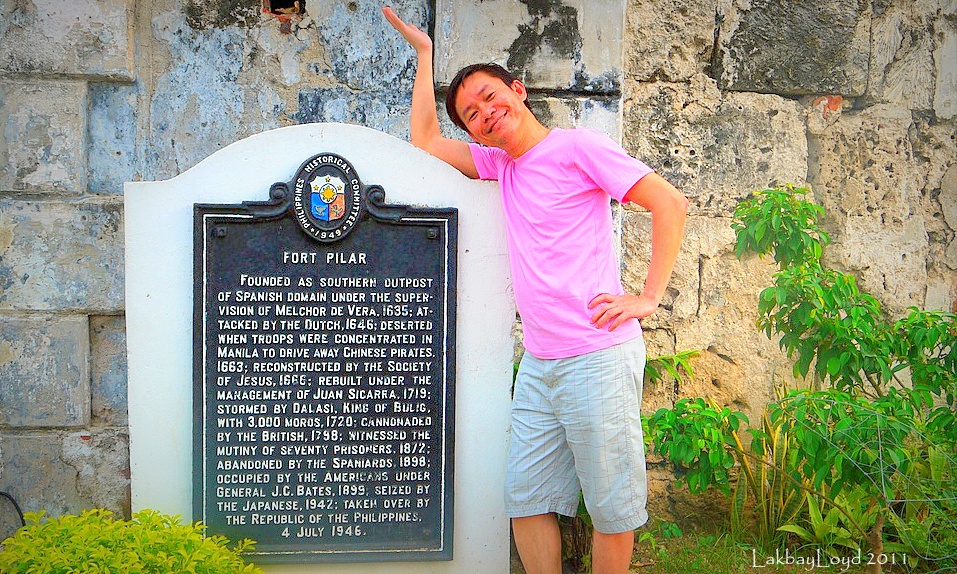
Fort Pilar was recognized a National Cultural Treasure on August 1, 1973. A 17th-century military defense fortress built by the Spanish colonial government in Zamboanga City, it was originally named as Real Fuerza de Nuestra Señora del Pilar de Zaragoza or Royal Fort of Our Lady of the Pillar of Zaragoza.

Fort Pilar is a unique structure in any aspects, being an open- air shrine without doors, right in the middle if the City. It is like a permanent invitation for all the Zamboangueños to come at any time of the day or night. There is probably not a single day or night Fort Pilar was found deserted of the locals, pilgrims and tourists.

The Marian Image honored at the Fort is a small replica of the original Nuestra Señora del Pilar in Saragossa, Spain. The Blessed Virgin is believed to have been watching the city and guarding Zamboanga against foreign invasions and natural calamities like quakes and tsunamis.


National Cultural Treasure Series - SAN IGNACIO DE LOYOLA PARISH, Capul, Northern Samar

Set in the middle of the San Bernardino Strait in Northern Samar is the island town of Capul - a small piece of enticing island rich in history and culture.

One of the evidences of the island's historic past (aside from the famous Capul Island Lighthouse) is the San Ignacio De Loyola Parish, a 400-year old stone church that has been declared as a National Cultural Treasure by the National Museum of the Philippines in 2014. The church is surrounded by stone walls connoting that it was more than a house of worship, as it was also a fortress and a refuge of the Capuleños during the times of Moro raids. At present it looked like a mini-Intramuros.


Capul was originally named Abak after the name of the chieftain, the deposed King Abak of Java, Indonesia. These migrants landed and settled on the island and brought with them one of the eight rarest dialects in the country - the Inabaknon.

The island is now called Capul from the word Acapulco, a contraction of the name Acapulco in Mexico where the galleon trade with Manila flourished. During the Spanish era, it became a frequent stop-over for galleons that came in and out of the Philippines during the Acapulco Trade. The island was a safe harbor for galleon traders when strong currents prevailed.

LinkWithin

Related Posts with Thumbnails