Sunday, December 31, 2017
Sunday, December 24, 2017
South Cebu Series - Oslob
Oslob is a 4th class municipality located down south of Cebu province and recently gained voluminous attention from both local and foreign tourists. Visitors have to travel for three and a half hours to reach Oslob which is 120 km away from Cebu City.
What to see in Oslob?
Oslob is not a place just to watch or swim with the butandings or whalesharks. It has more to offer that meets the eye. Evidences of rich history, culture and heritage can be seen and explored in the Oslob Heritage Park.
The centerpiece of the Oslob Heritage Park is the Church of Immaculate Conception. The present-day church of cut coral stone had blended so well with the overall look of the park. The church building is said to have its first construction started in 1830 and finished 18 years later. The buttresses that were added were constructed between 1848 and 1850. The adjacent bell tower was built in 1858.
Part of the Oslob heritage park is the Cuartel, an unfinished building made of coral blocks resembling a Spanish-era barracks. It is said that the Cuartel was intended to be the barracks for Spanish soldiers or guardia civil. It was started about 1860 but remained unfinished at the end of Spanish occupation in 1898.
The “Baluarte” or the watchtower, which can also be found at the Heritage park of Oslob was built in 1788. Its main purpose was to provide a safe place wherein local guards could observe the surrounding area against the invasion of the Moros.
One of the nicest parts of the Heritage Park is its Baywalk. This is where visitors of Oslob and even the locals can relax and unwind especially during the late afternoon when the sun is already cooler.
South Cebu Series - Carcar
Known as the Heritage City of Cebu, the City of Carcar is home to various Spanish- and American-era houses and structures. Carcar bacame a component city of the province of Cebu in a referendum on July 2007. It is 42 km away from Cebu City.
What to see in Carcar?
One of the most famous Spanish period structures in Carcar is the Saint Catherine of Alexandria Parish Church. The Greek Orthodox style inspires the main facade of the parish church because the domes of the two bell towers are similar to the bell towers of churches of the Greek Orthodox religion.
The parish church’s ceiling has beautiful symmetrical drawings and decorations. The concrete fence surrounding the church plaza has statues of saints standing on top of each fence column.
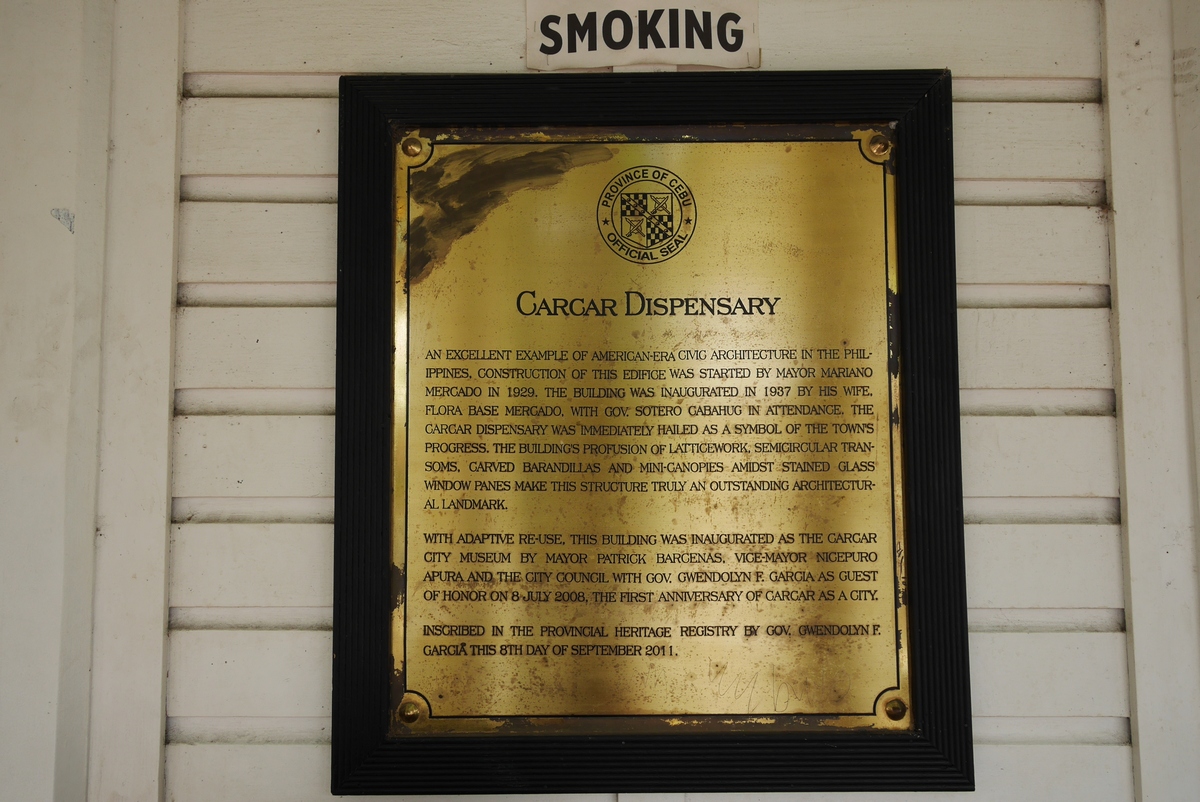
During the American period from 1922 to 1938, the then Mayor Mariano Mercado built several notable public structures in Carcar, including the Carcar Dispensary, the Rizal Monument, and the Carcar Rotunda. All of them are still standing until now. The Carcar Dispensary is now a public museum.
Located in the Carcar Plaza is the Carcar rotunda, a gazebo-like structure with intricate designs, stairways on four sides and two statues on top of its roof.
Carcar has some fine old colonial houses that are worth looking at. This “Heritage City of Cebu” has around 50 houses built from the mid 19th century to the early 20th century. Most of them are concentrated along Santa Catalina Street and the National Highway towards the Rotunda.
South Cebu Series - Sibonga
Sibonga is situated in the southeastern coast of Cebu and is about 50 kilometers from Cebu City. The municipality is bounded on the north by the municipality of Carcar, on the west by the municipalities of Dumanjug and Ronda, on the south by the municipality of Argao and on the east by Cebu Strait.
What to see in Sibonga?
The Monastery of the Holy Eucharist, popularly known as Simala Shrine or Simala Church, is a castle-like church located in Marian Hills of upper Lindogon, Simala, Sibonga, Cebu. Simala Shrine was built in 1998 by the Marian Monks from Pampanga, after the occurrence of several miraculous events, including that of Mama Mary's shedding of tears. Because of the said miracles, Simala Shrine became so popular that devotees and believers flock the shrine, hoping and believing that their prayer requests would be granted.
The shrine's castle-like and picturesque structure makes it even more popular, drawing local and foreign tourists, alike.
South Cebu Series - Argao
The town of Argao is considered as one of the oldest towns in the province of Cebu, having been founded by the Spaniards and established as a pueblo in the year 1608.
What to see in Argao?
The church of St. Michael the Archangel in Argao was built in 1783 during the time of Fr. Francisco Espina who was the parish priest from 1782 to 1798. It bears a striking resemblance with the San Guillermo de Aquitania Church in Dalaguete.
Sporting influences of baroque and rococo, the church features a three-level facade that is divided into segments by pilasters. At the lower level is a paired pilaster each with a carved-relief of a cherub clinging to an ornamental plant on one hand while carrying another plant on the other hand.
The eastern portal that opens to the sea seems to have doubled as a watchtower since a small door beside it opens to a narrow passageway to the top. Just beside this portal is the mortuary chapel that was recently rediscovered after being hidden for years behind an out-patient department building of a nearby hospital. This contemporary structure was torn down recently thus finally exposing the stone chapel.
The entire church complex, the municipal hall and the two-level coral stone building which is now a courthouse were once enclosed by a defensive wall of stone with bastions. Parts of the wall including the three portals still exist.
Like mangoes and Danggit, Torta is one of the delicacies that the province of Cebu is proud of. It comes in a wide variety of cooking styles, sizes, tastes, and presentations, but the torta that comes from Argao is considered the original and most delicious type.
It has become famous among local and international visitors. In fact, a large, symbolic torta was constructed in front of the municipal complex to regard its popularity.
Subscribe to:
Posts (Atom)